Chimney Repair and Tuckpointing in Rockford, IL
Updated
Short answer
What chimney repair means
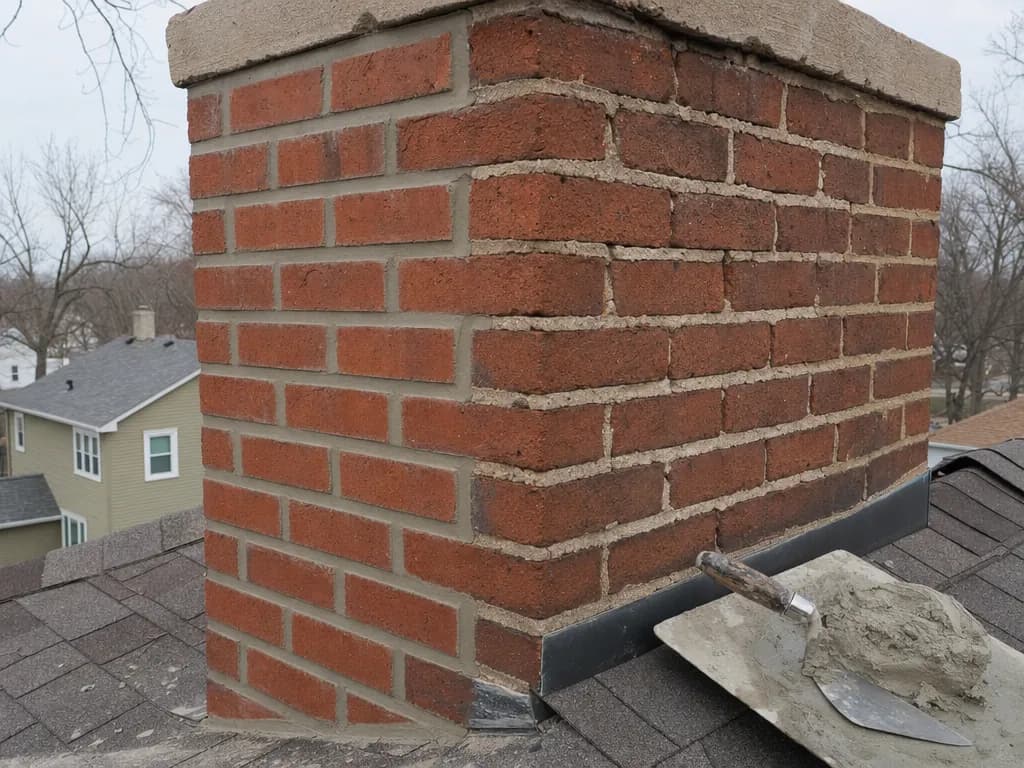
A masonry chimney is brick or stone held together by mortar. The brick lasts a long time. The mortar between the bricks does not, and neither does the surface of soft old brick. Most chimney repair is one of three jobs: replacing eroded mortar joints (tuckpointing or repointing), patching or replacing cracked and flaking bricks, and sealing small cracks before water gets in. Anything bigger is a rebuild. Problems at the top of the stack belong to crown repair or leak repair.
Signs the masonry needs work
- Mortar joints are recessed, crumbling or sandy, and you can scrape them with a key.
- Bricks have flaking faces, or the face has popped off. This is called spalling.
- White powder (efflorescence) shows on the brick. It means water is moving through the masonry.
- The stack leans, or there is a step crack running through the joints.
- Bits of brick or mortar land in the yard, on the roof or in the firebox.
- There are stains on the interior wall or ceiling next to the chimney.
A homeowner can see a lot of this with binoculars from the ground. A chimney inspection confirms it and checks the flue inside, which binoculars cannot.
How tuckpointing is done, step by step
- The mason grinds or chisels the old mortar out of the joints to a consistent depth. Cutting too shallow is the common failure; new mortar needs depth to hold.
- Dust and loose material are cleaned out and the brick is dampened so it does not pull water out of the new mortar too fast.
- Fresh mortar is packed into the joints in layers, then tooled to match the old joint profile.
- Cracked or spalled bricks are cut out and replaced with brick that matches in size and color.
- The surface is cleaned. Some crews finish with a water repellent that lets the brick breathe.
The new mortar has to be softer than the brick or the same strength. On an old house with soft brick, hard modern mortar can crack the brick faces instead of the joint. Ask the mason what mortar mix they use and why.
Replacing brick
When a brick face has spalled, patching it with mortar is a short-term fix. The better repair cuts the damaged brick out and sets a matching one in its place. Matching takes time. Old brick comes in many colors and sizes, and a good mason may pull a salvage brick from a part of the chimney that is hidden. Spalling often has a cause: a missing cap, a failed crown or constant water from a leaking gutter. Fix the cause or the new brick will fail too.
What drives the price
Typical price, national
- Tuckpointing: $500 to $2,500. Angi, chimney rebuild and masonry repair cost, updated October 6, 2026.
- Small crack repair: $150 to $500. HomeGuide, chimney repair cost, updated January 22, 2026.
- Spalling brick: $1,000 to $3,500. HomeGuide, chimney repair cost, updated January 22, 2026.
No cost guide publishes a Rockford, Chicago or Illinois chimney price (Angi's Chicago pages return 404, and HomeGuide and Thumbtack have none), so every range on this site is a national figure and is labelled that way.
Angi, chimney rebuild and masonry repair cost (updated October 6, 2026) puts tuckpointing at $500 to $2,500 and notes repointing runs $4 to $25 per square foot. HomeGuide, chimney repair cost (updated January 22, 2026) gives the same tuckpointing range, small crack repair at $150 to $500 and spalling brick repair at $1,000 to $3,500. The spread comes from the area of masonry, how high the roof is, whether scaffolding is needed and how much brick has to be replaced rather than pointed.
A stack with joints gone on only one face costs far less than one that needs all four. Ask for a price by the area or by the face so you can compare quotes. The tuckpointing versus rebuilding guide covers when repair stops making sense. The cost page lists the whole job range.
Why Rockford chimneys wear out the way they do
Rockford's median home was built in 1963, and 22.4% of its housing units date from before 1940 (Census ACS 5-year). Across Winnebago County, 35.5% were built before 1960. Chimneys that age are on their second or third round of mortar, if they have had any.
Climate does the rest. Rockford averages 21.8 F in January with 6,497 heating degree days a year (National Weather Service, 1991 to 2020 normals). Rain and snowmelt soak into open joints, then freeze and force the surface off. A chimney sticks up above the roof and takes wind, rain and sun on every face. It ages faster than the wall of the house.
Historic districts and permits
If the house is a Rockford landmark or sits in a local historic district, exterior changes visible from the street need a Certificate of Appropriateness from the Historic Preservation Commission before the building permit. The city's 2024 Design Guidelines say original chimneys should not be removed or altered and should be repointed to match the original. Ordinary maintenance that does not change the material or appearance needs no certificate. Check with the city before you start, and see the historic district guide.
No permit page we read names chimney repair as permit-free or permit-required, except Pecatonica, which lists chimneys among its required inspections. Rockford's rule covers repair or alteration of a structure over 120 square feet. The safe move is a call to your building office before a bigger masonry job. In unincorporated areas that is the Winnebago County Building Division.
Illinois contract rules for masonry work
Chimneys are named in the Home Repair and Remodeling Act
“"Home repair and remodeling" includes the construction, installation, replacement, or improvement of driveways, swimming pools, porches, kitchens, bathrooms, basements, chimneys, chimney liners, garages, fences...”
That brings two rules into play over $1,000: a signed written contract that lists the total cost and materials, and the state consumer rights pamphlet before you sign. Illinois does not license chimney contractors at the state level, so the contract is your protection. The hiring guide covers the red flags.
What happens if you wait
Masonry damage is cheap while it is small and expensive once it spreads. Open mortar joints let water in. In winter that water freezes, expands and pushes the joint and the brick face apart, so the next thaw lets in more. Spalled brick exposes the soft interior of the brick, which erodes faster. Water that works through the stack can reach the flue tile, the framing around the chimney and the ceiling below. The price ladder tells the story: Angi puts tuckpointing at $500 to $2,500, HomeGuide puts spalling brick repair at $1,000 to $3,500, and a partial rebuild runs $1,000 to $5,000 (Angi). A chimney that is repointed on time rarely reaches the last number.
Timing the work
Mortar needs to cure in mild, dry weather. In the Rockford area that usually means spring through fall. Rockford averages 21.8 F in January, which is no weather for fresh mortar. If an inspection finds a problem in November, ask whether the crew can make the stack watertight for winter, with a temporary cover or a crown seal, and do the masonry in spring. Fall is also when wood-burning owners want a fireplace they can use, so book early. Summer work on a chimney that houses swifts is a legal problem; see animal removal.
Matching old brick and mortar
Older Rockford houses often have soft, historic brick and a lime-rich mortar. New brick and modern mortar can look and behave differently. A good mason tests the joint, picks a mix that is no harder than the brick, and matches the joint width and tooling so the repair does not stand out. Ask to see a small sample area before the whole stack is done. For a house in a historic district, the Design Guidelines say chimneys should be repointed to match the original, so the match is part of the approval.
Questions to ask before you hire
- How deep do you grind the joints, and what mortar mix will you use on my brick?
- Is the price by the area, the face or the whole stack? Does it include scaffolding?
- How many bricks do you expect to replace, and how will you match them?
- Will you check the crown and flashing while you are up there? Water often gets in at the top, not through the face.
- Is the job in a historic district? Who handles the Certificate of Appropriateness?
Tell us what you see and we reply with a price first. Nothing starts until you agree to it.
Sources: Angi, chimney rebuild and masonry repair cost; HomeGuide, chimney repair cost; Home Repair and Remodeling Act, 815 ILCS 513; Home Repair and Remodeling Act, 815 ILCS 513/15; Illinois Attorney General, How to Choose a Contractor; City of Rockford, Building Permits; City of Rockford, Property Standards; City of Rockford, Historic Preservation Design Guidelines (2024); City of Rockford, Certificate of Appropriateness instructions (PDF); City of Rockford, Historic Districts; Winnebago County, Building Division; Village of Pecatonica, Building Permits; National Weather Service, Rockford normals 1991-2020; U.S. Census Bureau, ACS 2020-2024 5-year, via Census Reporter
Where this is done
Chimney Repair and Tuckpointing across Winnebago County. Each town page has its own local rules and numbers; the rest are on the service area page.
Common questions
Chimney Repair and Tuckpointing: questions
How much does chimney repair cost?
Angi puts tuckpointing at $500 to $2,500. HomeGuide prices small crack repair at $150 to $500 and spalling brick at $1,000 to $3,500. These are national figures, with no Rockford price published. See the cost page for every job.
What is tuckpointing?
Tuckpointing, also called repointing, grinds out the failing mortar between bricks to a set depth and packs in fresh mortar matched to the old joint. It restores the seal against water without replacing the brick.
What causes bricks on a chimney to flake or crumble?
Water gets into the brick, freezes and expands, and the face breaks away. The cause is almost always water: open mortar joints, a cracked crown, bad flashing or a missing cap. Fixing the brick without fixing the source brings it back.
How often does a chimney need tuckpointing?
There is no fixed schedule. Mortar lasts for decades, but a Rockford chimney sees repeated freezing and thawing. A yearly look from the ground and a Level 1 inspection will show joints going soft before they open.
Is it better to repair or rebuild a chimney?
Repair makes sense when the damage is in the joints and a limited number of bricks. A stack that leans, has widespread spalling or has cracks through the masonry is usually a rebuild. The tuckpointing versus rebuilding guide compares the two.
Do I need a permit to repair my chimney in Rockford?
The city's permit page does not name chimney work either way, and its rule covers repair or alteration of a structure over 120 square feet. Call Construction and Development Services before a large masonry job. A historic district house needs a Certificate of Appropriateness for exterior changes.
Why is there white powder on my chimney bricks?
The white powder is efflorescence, salts left behind when water moves through the masonry and evaporates. It is a sign of moisture entering, not a stain to scrub off. Find where water is getting in: the crown, the cap, the flashing or the joints.
Does Illinois license chimney repair contractors?
We found no state chimney contractor license. The Home Repair and Remodeling Act names chimneys and chimney liners, and for work over $1,000 it requires a signed written contract and a consumer rights pamphlet before you sign.
Other services
Chimney Repair and Tuckpointing in Winnebago County
Tell us what you burn, when the chimney was last swept and what you have noticed. We reply with a price first, and nothing starts until you agree to it.