Chimney Crown vs Chimney Cap: What Is the Difference?
Updated
Short answer
Part of Chimney Crown Repair.
People use the two words as if they meant the same thing, and some contractors do too. They are two different parts at the top of a masonry chimney. One protects the brick. The other protects the flue. If you are reading a quote or an inspection report, knowing which is which tells you what the repair really is. The crown work lives on our chimney crown repair page and the cap work on our chimney cap installation page.
The crown: a slab that sheds water
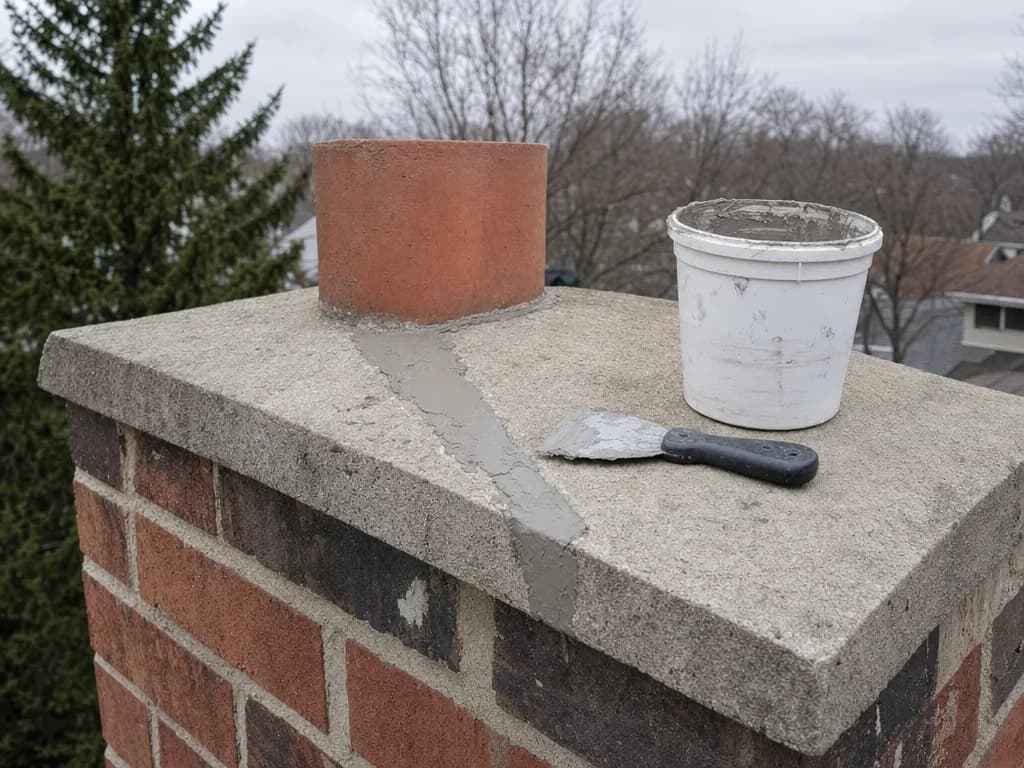
The crown (some masons call it the wash) is a layer of concrete or mortar poured across the top of the brick stack. It fills the space between the outside of the flue liner and the outer edge of the chimney, and it slopes outward so rain runs off the edge instead of soaking into the brick below. It also overhangs the sides a little, so water drips clear of the face of the chimney.
The building code describes the same job in different words. The 2021 International Residential Code, which Rockford has followed since January 1, 2025, says this in section R1003.9.1:
“Masonry chimneys shall have a concrete, metal or stone cap, a drip edge and a caulked bond break around any flue liners in accordance with ASTM C1283. The concrete, metal or stone cap shall be sloped to shed water.”
The code calls the sloped slab a “cap.” In everyday trade talk that slab is the crown, and the part sold as a “chimney cap” is the cover described below. The code also asks for a drip edge and a caulked gap around each flue liner. That gap matters: the liner expands and shrinks with heat, and a crown poured rigidly around it will crack.
Rockford is hard on this part. The National Weather Service normals for 1991 to 2020 put the January average at 21.8 F, with 6,497 heating degree days a year. Water that gets into a hairline crack freezes, expands and widens the crack, and then does the same thing again after the next thaw. Many Rockford houses are old to begin with: 22.4% of the homes in the city were built before 1940, and a crown from that era may be plain mortar rather than a reinforced pour.
How a crown fails
- Hairline cracks that run across the top, or a crack where the crown meets the flue tile.
- Crumbling or flaking edges, with bits of mortar on the roof or in the gutter.
- A flat top with no slope, so water sits on it.
- Water stains, white mineral deposits or loose mortar on the brick just under the top course.
You can often see these from the ground with binoculars. Do not climb on a Rockford roof in winter to check. A Level 1 inspection includes the visible exterior of the chimney, and a sweep who goes on the roof can photograph the crown for you.
What crown work costs
There are three levels of repair: a sealing coat over small cracks, a patch or resurface when the damage is wider, and a full replacement when the slab is breaking apart. These are national figures from cost guides. No guide publishes a Rockford price, so treat them as a starting point and get a written quote.
Typical price, national
- Crown reseal: $175 to $600. Angi, chimney crown repair cost, updated March 17, 2026.
- Crown repair: $300 to $2,200. Angi, chimney crown repair cost, updated March 17, 2026.
- Crown replacement: $1,800 to $3,000. Angi, chimney crown repair cost, updated March 17, 2026.
- Crown replacement: $1,000 to $3,000. HomeGuide, chimney repair cost, updated January 22, 2026.
National ranges. See the cost page for every chimney price and its source.
The cap: a cover over the flue
The cap sits on top of the flue opening (or over the crown on a chimney with more than one flue) and does three jobs. It keeps rain out of the flue. It keeps animals and birds out. On a wood-burning flue it catches sparks and embers with a mesh screen. Caps are usually stainless steel, galvanized steel or copper, with mesh sides and a solid lid on top.
The same code section has rules for the mesh. A spark arrestor must have a net free area at least four times the net free area of the flue outlet, and its openings must not pass a sphere larger than a half inch or block one smaller than three-eighths of an inch. A rain cap needs the same four-to-one free area, so it does not choke the flue. The code text is on the ICC site. Our guide to why a chimney needs a cap covers what happens when there is no cap at all.
Typical price, national
- Chimney cap, installed: $190 to $650. Angi, chimney cap cost, updated April 6, 2026.
- Chimney cap, installed: $200 to $850. HomeGuide, chimney cap cost, updated February 9, 2026.
National ranges. Angi's average is $300. No guide we reviewed prices a chase cover.
Side by side
| Question | Crown | Cap |
|---|---|---|
| What is it? | Sloped concrete or mortar slab on top of the brick | Metal cover with mesh sides over the flue opening |
| What does it protect? | The brick and mortar below it | The flue and everything that can fall into it |
| Usual failure | Cracks and crumbling from freeze and thaw | Rust, a missing or bent lid, torn mesh |
| What a failure lets in | Water into the masonry | Rain, birds, animals and debris into the flue |
| Typical fix | Seal, patch or replace the slab | Replace the cap |
A chase cover is a third thing
Many newer houses have a factory-built fireplace inside a framed box called a chase, with a metal chimney pipe coming out the top. That box has no brick crown. Instead it has a sheet-metal chase cover, and the pipe has its own cap. No cost guide we reviewed prices a chase cover on its own, so ask for it as a line item on the quote. The page on chimney leak repair covers the flashing and cover details that go with it.
Which one is causing your problem?
- Water stains on the ceiling or wall near the chimney in a heavy rain usually point to the crown, the flashing or the brick, not the cap. Start with the guide to a chimney leaking when it rains.
- Birds, nest material or a raccoon in the flue point to a missing or broken cap. Chimney swifts are protected, so check the swift guide before anything is removed.
- Crumbling mortar lower down the stack is a masonry problem. See tuckpointing versus rebuilding.
If both parts are in poor shape, ask the contractor to sequence the work. A cap is often fastened to the flue tile or the crown, so a new crown may mean the cap comes off and goes back on, or is replaced at the same visit. Prices for each job are on the cost page.
Sources: Angi, chimney crown repair cost; HomeGuide, chimney repair cost; Angi, chimney cap cost; HomeGuide, chimney cap cost; National Weather Service, Rockford normals 1991-2020; City of Rockford, Building Codes and Ordinances; ICC, 2021 International Residential Code, Chapter 10 Chimneys and Fireplaces (R1003.9 Termination)
Quick answers
What is the difference between a chimney crown and a chimney cap?
The crown is the sloped concrete or mortar slab across the top of the brick. It sheds rain off the masonry. The cap is the metal cover over the flue opening. It keeps out rain, animals and sparks.
How much does chimney crown repair cost?
Angi lists $175 to $600 for a reseal, $300 to $2,200 for a repair and $1,800 to $3,000 for a replacement (national, March 17, 2026). No guide gives a Rockford price. The cost page lists every source.
Does a chimney need both a crown and a cap?
A masonry chimney needs a sloped top that sheds water, which is the crown. A cap over the flue is the usual way to keep out rain, animals and sparks. They protect different things, so one does not replace the other.
Can a cap stop a leak from a cracked crown?
A cap covers the flue only. Water that soaks into a cracked crown goes into the brick and mortar under it, which the cap does not cover. The crack itself needs sealing, patching or a new crown.
How much does a new chimney cap cost?
Angi lists $190 to $650 installed, with an average of $300 (national, April 6, 2026). HomeGuide lists $200 to $850. The cost page shows both with their dates.
What does the building code say about the top of a masonry chimney?
The 2021 International Residential Code, section R1003.9.1, asks for a sloped concrete, metal or stone cap, a drip edge and a caulked bond break around each flue liner. Rockford has followed the 2021 code since January 1, 2025.
Chimney due for a look?
Tell us what you burn, when the chimney was last swept and anything you have noticed. We reply with a price first.