The 3-2-10 Chimney Height Rule, Explained
Updated
Short answer
Part of Chimney Rebuilds and Removal.
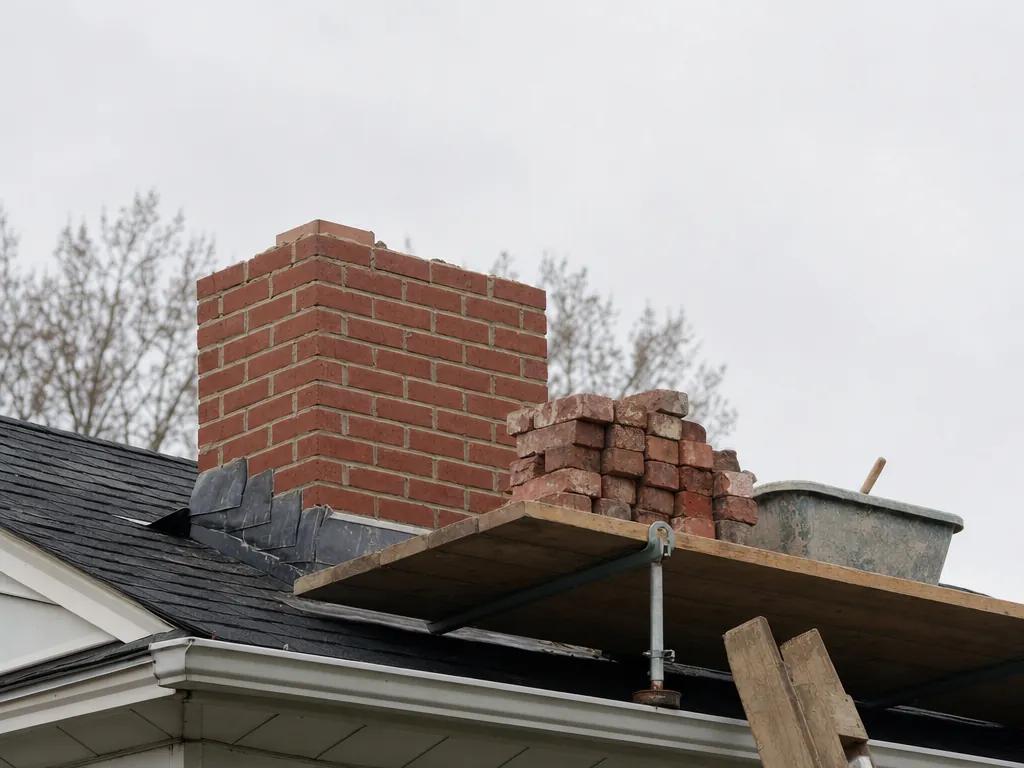
“3-2-10” is shorthand that builders and masons use for the chimney termination rule in the International Residential Code (IRC). It sets how tall a masonry chimney has to be above the roof. Height controls draft, and it keeps sparks and flue gas above the roof. A chimney that is too short can smoke into the room on windy days, which is one of the causes in why a fireplace smokes. This guide gives the actual code text, shows how to measure it, and says when it comes up. Rebuilds and extensions are on our chimney rebuild page.
The code text
The rule is in Chapter 10 (Chimneys and Fireplaces) of the 2021 IRC, section R1003.9. We read it on the International Code Council's code site:
“R1003.9 Termination. Chimneys shall extend not less than 2 feet (610 mm) higher than any portion of a building within 10 feet (3048 mm), but shall be not less than 3 feet (914 mm) above the highest point where the chimney passes through the roof.”
The same section goes on to caps, spark arrestors and rain caps (R1003.9.1 to R1003.9.3). The text above is exactly as the ICC publishes it, with the section number added for clarity. The code chapter covers masonry chimneys. Factory-built chimneys, metal flue pipes and the vents for gas appliances follow their own listings and manufacturer instructions, so the numbers on a manufacturer's label may differ. We did not research those rules here, so ask your building office if your chimney is not masonry.
Which edition applies where you live
The City of Rockford adopted the 2021 IRC with local amendments, effective January 1, 2025 (permits submitted on or after December 31, 2024). The amendments we could read change permit exemptions and flood elevation; we did not find one aimed at chimneys or fireplaces in the part that loaded. Loves Park, Machesney Park and Winnebago (the village) also list the 2021 IRC. The Winnebago County Building Division, which handles permits for Roscoe, Rockton, Cherry Valley, Durand, New Milford, South Beloit and the unincorporated areas, lists the 2015 IRC on its codes page, last modified February 20, 2025, and that listing looks old. We quote the 2021 text only. We did not check whether the 2015 wording is identical, so confirm with the Building Division at (815) 319-4350 if your house is in the county. Each town's permit office is on its page under service area.
How to read the three numbers
The 3 is about the roof opening. Find the spot where the chimney comes through the roof, and take the highest point of that contact. On a sloped roof, that is the uphill side of the chimney. The top of the chimney (the finished crown, not a cap) has to be at least 3 feet above that spot.
The 2 and the 10 go together. Look at everything that is part of the building within 10 feet of the chimney, measured horizontally. That includes the ridge of the roof, a taller part of the house, a dormer, or a second-story wall. The top of the chimney must be at least 2 feet higher than the highest of those.
Both tests apply, and the chimney has to pass both. Whichever test calls for the taller chimney sets the minimum.
A worked example (illustrative numbers)
- The roof peak is 6 feet from the chimney, so it falls inside the 10 foot zone, and it stands 4 feet higher than the roof at the chimney.
- Test 1 (3 feet above the roof penetration): the chimney top has to be 3 feet above the roof at the chimney.
- Test 2 (2 feet above anything within 10 feet): the chimney top has to be 2 feet above the peak, which is 4 feet higher than the roof at the chimney. So the chimney top has to be 6 feet above the roof at the chimney.
- Test 2 asks for more, so the chimney is built at least 6 feet above the roof where it passes through.
This example is made up to show the arithmetic. It is not a measurement of any house in Rockford. A chimney at the ridge of a simple gable roof usually passes on the 3 foot test alone. A chimney low on a steep roof, near a taller wing of the house, passes only on the 2 foot test.
When this rule shows up
- A rebuild. When a chimney is taken down and built again, the new height comes from the code in force. Angi prices a rebuild above the roofline per linear foot (national, October 6, 2026), so every extra foot is a cost.
- New construction nearby. A dormer, a second-story addition or a taller roof near an old chimney can leave it too short for the code. Smoke problems after an addition are a clue.
- A smoking fireplace. If the draft is poor and the chimney is short for its surroundings, adding height is one of the fixes. It is a rebuild-level job, so get a Level 2 inspection and a written quote first.
- A new stove or insert. A stove or insert install is permitted work in Rockford, Loves Park and Machesney Park. The permit office is the place to ask which height and clearance rules it will enforce.
Prices for partial rebuilds are on the cost page: Angi lists $1,000 to $5,000 (national, October 6, 2026), and no guide publishes a Rockford figure. In a Rockford historic district, the guidelines ask that rebuilt chimneys match the original, so a taller chimney may need approval. See chimney rules in Rockford historic districts.
Questions for the contractor
- What will the finished height be above the roof, and what is it measured from?
- Is anything taller within 10 feet of the chimney, and have you measured it?
- Will the new height need a permit, and will you pull it?
- If the chimney is in a Rockford historic district, who handles the Certificate of Appropriateness?
Put the finished height in the written quote. A contractor who has measured the roof will have the numbers ready.
What the rule does not tell you
It does not say a chimney is safe. A chimney can meet 3-2-10 and still be cracked, unlined or blocked. It also does not tell you where the chimney sits on the house, and the clearance of the chimney to wood framing is a separate rule in the same chapter. The inspection levels are in chimney inspection.
Sources: City of Rockford, Building Codes and Ordinances; City of Rockford, Local Amendments to the 2021 IRC; Winnebago County, Codes and Ordinances; Winnebago County, Building Division; City of Loves Park, adopted codes (March 2025); Angi, chimney rebuild and masonry repair cost; City of Rockford, Building Permits; ICC, 2021 International Residential Code, Chapter 10 Chimneys and Fireplaces (R1003.9 Termination)
Quick answers
What does 3-2-10 mean for a chimney?
The chimney must extend at least 3 feet above the highest point where it passes through the roof, and at least 2 feet higher than any part of the building within 10 feet. The taller result is the minimum height.
Which part of the code has the 3-2-10 rule?
It is section R1003.9, Termination, in Chapter 10 of the International Residential Code. Rockford follows the 2021 edition with local amendments, effective January 1, 2025.
Does the 3-2-10 rule apply to my existing chimney?
The code text governs construction and repair work, and we did not find a local rule that says how it treats a chimney that is already built. Ask Rockford Construction and Development Services at (779) 348-7158 or your town's permit office.
How is the 10 feet measured?
It is a horizontal distance from the chimney to any part of the building, such as a roof ridge, a dormer or a taller wall. Anything inside that zone sets a 2 foot clearance above it.
How much does it cost to raise a chimney?
Angi lists $1,000 to $5,000 for a partial rebuild above the roofline (national, October 6, 2026). No guide gives a Rockford price. The cost page shows the source.
Does a chimney cap count toward the height?
The height sentence in R1003.9 does not mention the cap. Ask the contractor to state the finished height in the written quote and what it is measured to and from.
Chimney due for a look?
Tell us what you burn, when the chimney was last swept and anything you have noticed. We reply with a price first.