How Often Should a Dryer Vent Be Cleaned?
Updated
Short answer
Part of Dryer Vent Cleaning.
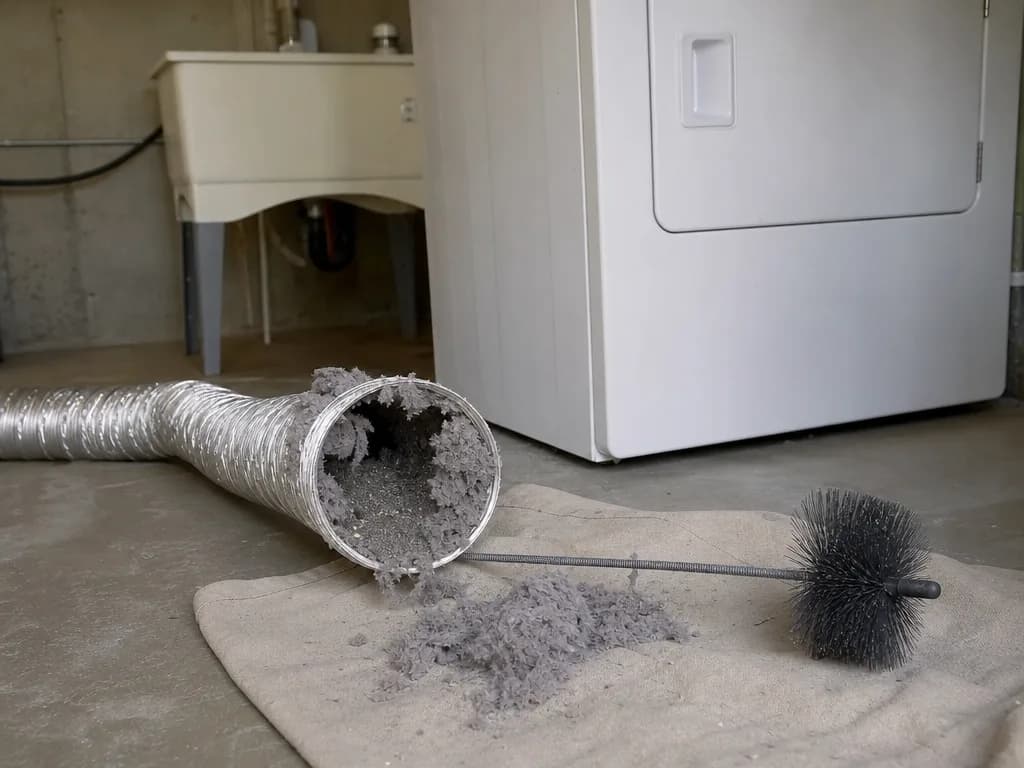
Search for this and you get “every year,” “every six months” and “every two years” from different sites, each stated like a rule. They are not one rule. They come from a federal agency, three appliance makers and two cost sites, and they were written for different purposes. This guide puts them side by side, says what pushes the interval up or down, and gives the fire data behind the question. The service itself is on our dryer vent cleaning page.
One clarification first. The lint screen is a separate job. The CPSC says to clean the lint screen “before or after drying each load of clothes.” The intervals below are for the vent pipe that carries air from the back of the dryer to the outside.
What each source says
| Source | Interval as the source words it | Date |
|---|---|---|
| CPSC news release | “Clean lint out of the vent pipe at least once a year.” | March 8, 2023 |
| GE Appliances | “Inspect and clean the exhaust ducting at least once a year to prevent clogging.” | undated support article |
| Samsung, cleaning page | “Clean your exhaust vent once or twice per year.” | December 2025 |
| Samsung, not-drying page | Once or twice each year “whether you experience issues or not.” | July 2024 |
| Whirlpool, vent cleaning article | “No less than once every two years, depending on how often it’s used and what kinds of loads you’re drying.” | March 2022 |
| Whirlpool, Check Vent light page | “Every one to two years or as needed when dry performance has decreased.” | December 2019 |
| Thumbtack cost guide | Ideally every six months (paraphrase of a cost guide, not a maker or agency rule). | updated July 8, 2026 |
The CPSC page is the only federal source we found with a number. Its safety alert, Publication 5022, says to clean the vent and exhaust duct “periodically” and gives no interval. The yearly figure comes from the 2023 news release. Whirlpool gives two different answers on two different pages, so even one maker is not consistent.
What the spread tells you
The floor is not the same everywhere. The CPSC and GE both start at once a year. Whirlpool’s longest allowance is two years, and its own page attaches conditions: how often the dryer runs, what you dry, and pet hair. Samsung is the most cautious maker. We did not find a source that explains how any of these numbers was set, and none of the agencies says that a given schedule prevents fires.
So treat the numbers as starting points. The lowest figure that any source gives is the one the CPSC and GE give, once a year, and it is the one we would use for a household that has not looked at its vent. Moving to twice a year or stretching toward two years is a judgment about your own setup. That judgment is our reading of the sources, not a rule from any one of them.
What moves your number
- How much you dry. Whirlpool says the interval depends on “the frequency of use, types of items dried, pet hair, etc.” A large household running daily loads is not in the same position as one person with a load a week.
- Pets. Whirlpool names pet hair on its Check Vent page. It gives no separate interval for it.
- Vent length and turns. Angi says the cleaning price spread is driven by vent location, total length and the number of duct turns. The Department of Energy’s weatherization job aid says “dryer vents with long runs or excessive bends create a fire hazard and increase dry time.” A long run with several elbows is a reason to lean toward the short end of the range. The length limits are in dryer vent code rules for Illinois.
- The kind of duct. The CPSC says foil or plastic accordion duct “can more easily trap lint” and is easier to kink or crush. If you have it, the interval matters less than replacing it.
- The outside cap. GE says snow or ice should not be allowed to build up around the outside wall cap. The U.S. Fire Administration says to check for nests of small animals and insects blocking the outside vent.
- Signs you can see. Damp clothes at the end of a cycle, a hot dryer or a burning smell mean the date on the calendar no longer matters. See signs your dryer vent is clogged.
Season also shows up in the data. The U.S. Fire Administration found that dryer fires in residential buildings were higher in fall and winter, peaking in January at 11 percent of the year’s total (2008 to 2010, national data, not a Rockford figure). That is a reason to check the vent before the cold months, not a finding that winter causes the problem.
What the fire data says
Three agencies count dryer fires, and the totals differ because they count different things and different years. We keep them apart.
- NFPA (2014 to 2018): about 13,820 home structure fires a year involved a dryer in the ignition, with seven civilian deaths, 344 injuries and $233 million in direct property damage a year on average. These are fires reported to fire departments. NFPA says 32 percent were caused by a failure to clean, and that 27 percent started when dust, fiber or lint ignited. In its table, failure to clean accounts for all seven of the average yearly civilian deaths. (NFPA, Home Dryer Fires (Index No. 3029))
- U.S. Fire Administration (2008 to 2010): about 2,900 reported residential dryer fires a year from the coded national fire database. It names failure to clean the leading contributing factor at 34 percent. (USFA, Clothes Dryer Fires in Residential Buildings (2008 to 2010))
- CPSC staff (2021 to 2023): an estimated 4,900 residential structure fires a year involving clothes dryers. (CPSC, 2021 to 2023 Residential Fire Loss Estimates)
Do not add these up or compare the totals as if they measured the same thing. The point they share is the cause. In both NFPA and the U.S. Fire Administration, failure to clean is the leading factor. What the reports measure is not cleaning on a schedule versus not. They count fires where cleaning was missed. That is evidence about the cause, not a promise that a cleaning prevents a fire.
What it costs to do it more often
Every extra visit is another bill. The ranges below are national, since no cost guide gives a Rockford price. Angi’s range is the lower of the two, and Thumbtack’s is roughly double. A twice-a-year schedule means paying for two visits in the same year. Other prices, including nest removal and a replacement duct, are on the cost page.
Typical price, national
- Dryer vent cleaning, Angi: $104 to $188. Angi, dryer vent cleaning cost, updated October 14, 2026.
- Dryer vent cleaning, Thumbtack: $186 to $510. Thumbtack, dryer vent cleaning cost, updated July 8, 2026.
National figures. No cost guide publishes a Rockford or Illinois price.
A working schedule
- Clean the lint screen every load, as the CPSC says.
- Check the outside flap with the dryer running at least once a season (the steps are in the signs guide).
- Have the vent pipe cleaned once a year if you have not had it cleaned before, so you start from a known state.
- Go to twice a year if you have pets, run the dryer most days, or have a long or bent run.
- Treat Whirlpool’s one-to-two-year range as the outer limit for a short, straight run with light use, and only while the dryer keeps drying in one cycle.
Cleaning the vent does not clean the inside of the dryer. The CPSC also says to have a qualified service person clean the interior of the dryer chassis periodically. If you would rather do the vent yourself, see whether you can clean a dryer vent yourself.
Sources: CPSC news release, Save Daylight, Save Lives; CPSC, Overheated Clothes Dryers Can Cause Fires (Publication 5022); CPSC, 2021 to 2023 Residential Fire Loss Estimates; GE Appliances, Dryer hot to the touch or sweats; Samsung, How to clean your Samsung dryer; Samsung, Clothes are not dry after using Samsung dryer; Whirlpool, How to clean a dryer vent; Whirlpool Product Help, Check Vent light; Thumbtack, dryer vent cleaning cost; Angi, dryer vent cleaning cost; NFPA, Home Dryer Fires (Index No. 3029); USFA, Clothes Dryer Fires in Residential Buildings (2008 to 2010); U.S. Department of Energy, Weatherization Installer Job Aid 17-1: Vent a Clothes Dryer
Quick answers
Is once a year enough for a dryer vent?
It matches the minimum from the Consumer Product Safety Commission and GE, who both say at least once a year. Samsung says once or twice a year. A long vent, pets or daily loads are reasons to go beyond once a year.
Why does Whirlpool say every two years when others say every year?
Whirlpool's article says no less than once every two years, depending on how often the dryer is used and what is dried. Its Check Vent page says one to two years or as needed when drying performance drops. Nothing in either page explains the gap with the CPSC.
Does a clean lint screen mean the vent is fine?
The lint screen only catches part of the lint. The CPSC lists the screen, the exhaust duct and the inside of the dryer as separate places where lint builds up, and says to clean each of them.
How often should I clean the vent if I have pets?
Whirlpool names pet hair as one of the things that decide your interval but gives no separate number for it. Start at the yearly figure from the CPSC and check for signs of a clog between cleanings.
What does it cost to clean a dryer vent twice a year?
Each visit is a separate charge. Angi lists $104 to $188 per cleaning and Thumbtack lists $186 to $510, both national. No guide gives a Rockford price. The cost page shows both sources.
Do fire statistics prove that cleaning prevents dryer fires?
They show the leading cause. NFPA (2014 to 2018) and the U.S. Fire Administration (2008 to 2010) both name failure to clean as the top factor. Neither agency says that a cleaning schedule prevents a fire.
Chimney due for a look?
Tell us what you burn, when the chimney was last swept and anything you have noticed. We reply with a price first.