
Dryer Vent Code Requirements for Rockford Homes
Updated
Short answer
Part of Dryer Vent Cleaning.
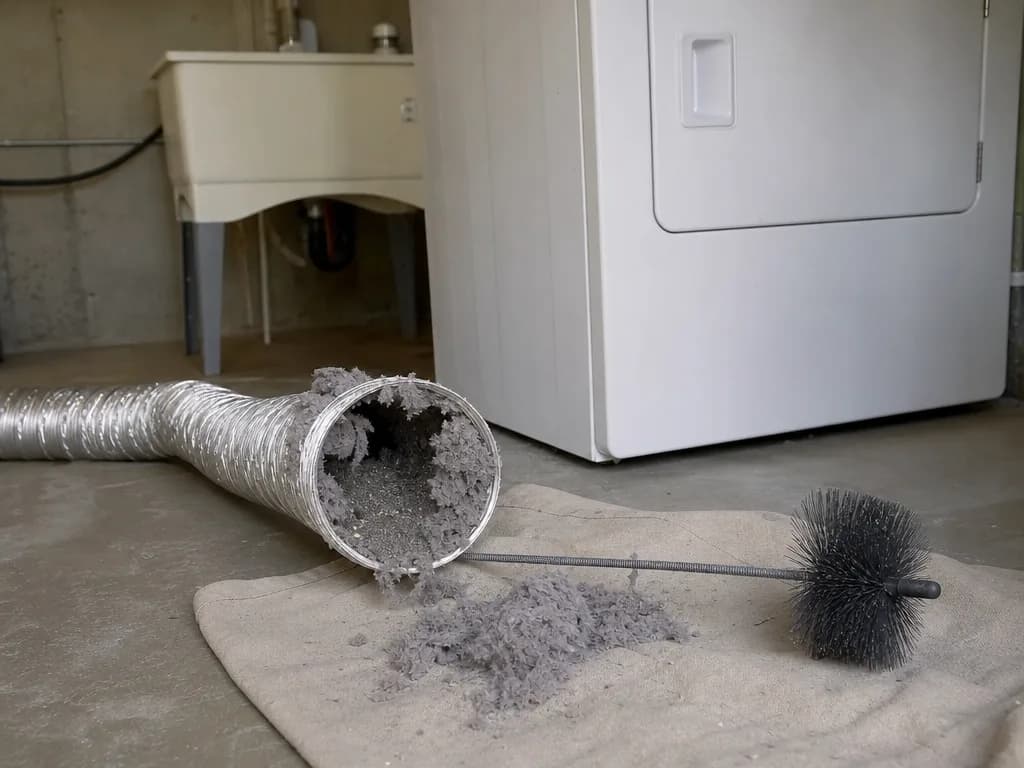
The rules for a dryer duct are in Chapter 15 of the International Residential Code (IRC), which covers one- and two-family homes. This guide quotes the sections that matter to a homeowner, shows which IRC edition each permit office around Rockford lists, and says plainly what we did not find. We are not a permit office and this is not legal advice. Cleaning the duct you have is on our dryer vent cleaning page, and the maintenance question is in how often to clean a dryer vent.
Which edition applies where
The permit office decides what a permit needs, including for dryer work. We did not find a Rockford, Loves Park, Machesney Park or Winnebago County rule written for dryer vents specifically. What our research holds for each office is the code edition it lists:
| Town | Permit office | Code listed |
|---|---|---|
| Rockford | City of Rockford, Construction and Development Services | 2021 IRC with city amendments (since Jan 1, 2025) |
| Loves Park | City of Loves Park Building Department (also inspects for Machesney Park) | 2021 IRC (Ordinance 4689-25) |
| Machesney Park | Machesney Park Building Division (inspections by Loves Park) | 2021 IRC (Ordinance 10-25) |
| Roscoe | Village of Roscoe (zoning) plus Winnebago County Building Division | County codes (page lists 2015 IRC, confirm) |
| Rockton | Village of Rockton (zoning) plus Winnebago County Building Division | County codes (page lists 2015 IRC, confirm) |
| South Beloit | Winnebago County Building Division (city adopts county permits and fees) | County codes (page lists 2015 IRC, confirm) |
| Cherry Valley | Winnebago County Building Division (Cherry Valley village) | County codes (page lists 2015 IRC, confirm) |
| Winnebago | Village of Winnebago, Building Safety and Permitting | 2021 IRC with village amendments (since Jan 1, 2025) |
| Pecatonica | Village of Pecatonica, Village Hall | No edition found |
| Durand | Village of Durand zoning approval, then Winnebago County Building Division | County codes (page lists 2015 IRC, confirm) |
| New Milford | Village of New Milford (zoning) plus Winnebago County Building Division | County codes (page lists 2015 IRC, confirm) |
The county's own codes page lists the 2015 IRC and looks stale, so confirm with the Building Division at (815) 319-4350. In Rockford, Construction and Development Services is at (779) 348-7158. Ask whether your work needs a permit, such as moving the duct through a new wall.
The 2021 and 2015 chapters agree on the points below: 4 inch smooth metal duct, 35 feet maximum length with fitting allowances, no screens at the end, and the limit on screws. They differ in a few places, and we say where. We quote the 2015 text for the backdraft damper wording because the 2021 version of that section reads oddly on the ICC page we retrieved, and the 2021 fuel gas chapter states the damper rule plainly.
Exhaust to the outside, on its own
IRC 2021, M1502.1 and M1502.2
“M1502.1 General. Clothes dryers shall be exhausted in accordance with the manufacturer’s instructions. M1502.2 Independent exhaust systems. Dryer exhaust systems shall be independent of all other systems and shall convey the moisture to the outdoors.”
The manufacturer’s instructions come first. Where they set a different maximum length, the code lets them. The Department of Energy’s weatherization job aid says “ducted to exterior” does not include unconditioned attics, crawl spaces or other areas that are ventilated to the outdoors.
The end of the duct
IRC 2015, M1502.3 (the county's listed edition)
“Exhaust ducts shall terminate on the outside of the building. Exhaust duct terminations shall be in accordance with the dryer manufacturer’s installation instructions. If the manufacturer’s instructions do not specify a termination location, the exhaust duct shall terminate not less than 3 feet (914 mm) in any direction from openings into buildings. Exhaust duct terminations shall be equipped with a backdraft damper. Screens shall not be installed at the duct termination.”
Two things here show up in real houses. The backdraft damper is the flap you check in the outside flap test. And there are no screens: lint catches in a screen and closes the opening. The Department of Energy job aid agrees, listing a termination with a backdraft damper and “no cage.” The 2021 edition adds a minimum open area for the termination of not less than 12.5 square inches, which we did not find in the 2015 text we retrieved.
Size, material and screws
IRC 2021, M1502.4.1 (2015 has the same size and gage)
“Exhaust ducts shall have a smooth interior finish and shall be constructed of metal not less than 0.0157 inch (0.3950 mm) in thickness (No. 28 gage). The duct shall be 4 inches (102 mm) nominal in diameter.”
IRC 2021, M1502.4.2, fasteners
“Ducts shall not be joined with screws or similar fasteners that protrude more than 1/8 inch (3.2 mm) into the inside of the duct.”
The limit is 1/8 inch, not “no screws.” A screw that sticks into the duct snags lint. The Department of Energy job aid puts it as “no screws penetrating into duct.” A cleaner can see protruding screws once the duct is apart.
We deliberately do not give a spacing interval for duct supports. The 2021 IRC gives 12 feet in one place and 4 feet for gas dryers in another, and the two do not agree. Ask the permit office, or follow the dryer maker’s instructions.
Foil and plastic duct
The code allows a flexible piece only as a transition duct between the dryer and the wall:
IRC 2021, M1502.4.3 (the same in 2015)
“Transition ducts used to connect the dryer to the exhaust duct system shall be a single length that is listed and labeled in accordance with UL 2158A. Transition ducts shall be not greater than 8 feet (2438 mm) in length. Transition ducts shall not be concealed within construction.”
Outside of that, makers and the CPSC point to rigid metal. Whirlpool’s installation sheet says: “Flexible venting materials are known to collapse, be easily crushed, and trap lint. These conditions will obstruct clothes dryer airflow and increase the risk of fire.” The CPSC says to replace plastic or foil accordion duct with rigid or corrugated semi-rigid metal. We say that rigid metal is what makers and the CPSC specify. We do not say that every flexible duct is illegal, because the code allows the listed transition piece.
How long the run can be
IRC 2021, M1502.4.6.1 (2015: M1502.4.5.1, same numbers)
“The maximum length of the exhaust duct shall be 35 feet (10 668 mm) from the connection to the transition duct from the dryer to the outlet terminal. Where fittings are used, the maximum length of the exhaust duct shall be reduced in accordance with Table M1502.4.6.1. The maximum length of the exhaust duct does not include the transition duct.”
The table in that section sets what each fitting costs you. A 4 inch radius mitered 90 degree elbow counts as 5 feet of the 35 feet. A 4 inch radius mitered 45 degree elbow counts as 2 feet 6 inches. Four 90 degree elbows use up 20 feet. The dryer maker’s instructions can set a different maximum. A run whose equivalent length is over 35 feet must carry a permanent label or tag within 6 feet of the connection that states the length. The Department of Energy job aid says “if duct run must exceed 35 feet, install booster fan.” That wording differs from the IRC, which handles a longer run with the label or a power ventilator listed to UL 705. Short and straight is the DOE’s advice either way.
Gas dryers
Chapter 24 of the 2021 IRC adds rules for gas dryers:
IRC 2021, G2439.1
“Clothes dryers shall be exhausted in accordance with the manufacturer’s instructions. Dryer exhaust systems shall be independent of all other systems and shall convey the moisture and any products of combustion to the outside of the building.”
IRC 2021, G2439.3
“Exhaust ducts for clothes dryers shall terminate on the outside of the building and shall be equipped with a backdraft damper. Screens shall not be installed at the duct termination. Ducts shall not be connected or installed with sheet metal screws or other fasteners that will obstruct the flow. Clothes dryer exhaust ducts shall not be connected to a vent connector, vent or chimney. Clothes dryer exhaust ducts shall not extend into or through ducts or plenums.”
The sentence about chimneys matters on an older house with an unused flue: a dryer does not vent into one. For what the vent does on a gas dryer in practice, see signs your dryer vent is clogged and the Illinois carbon monoxide alarm law.
What we did not find
- No local ordinance in Rockford, Loves Park, Machesney Park or Winnebago County written for dryer vents. If one exists, the permit office will tell you.
- No make-up air rule for dryers. The section title exists in the gas chapter but the paragraph did not load, so we state no threshold.
- No Illinois dryer vent cleaning license. See the contractor facts in can you clean a dryer vent yourself.
- The International Mechanical Code section on dryer exhaust, which we did not retrieve. The IRC chapters above cover one- and two-family homes.
If you are replacing or moving a duct, a price is on the cost page: HomeGuide lists $200 to $800 for a new vent through an exterior wall and $200 to $500 for a reroute (national, no Rockford price).
Sources: ICC, 2021 International Residential Code, Chapter 15 Exhaust Systems; ICC, 2015 International Residential Code, Chapter 15 Exhaust Systems; ICC, 2021 International Residential Code, Chapter 24 Fuel Gas; CPSC, Overheated Clothes Dryers Can Cause Fires (Publication 5022); Whirlpool, dryer venting specifications; U.S. Department of Energy, Weatherization Installer Job Aid 17-1: Vent a Clothes Dryer; City of Rockford, Building Codes and Ordinances; Winnebago County, Codes and Ordinances; City of Loves Park, adopted codes (March 2025); HomeGuide, dryer vent installation and replacement cost; HomeGuide, dryer vent repair and reroute cost
Quick answers
How long can a dryer vent be under the code?
The IRC allows 35 feet from the connection to the transition duct to the outside, reduced for fittings. A 4 inch mitered 90 degree elbow counts as 5 feet. A dryer maker's instructions can set a different limit.
What size and material must a dryer duct be?
The IRC calls for a smooth metal duct, 4 inches nominal in diameter, in No. 28 gage or thicker. Only a listed transition duct, no longer than 8 feet, may connect the dryer to it.
Can a dryer vent have a screen over the end?
The IRC says screens shall not be installed at the duct termination, in both the 2015 and 2021 editions. The outside end needs a backdraft damper, which is the flap that opens when the dryer runs.
Which code edition does Rockford use for dryer vents?
Rockford lists the 2021 IRC with city amendments, effective January 1, 2025. Loves Park and Machesney Park also list the 2021 edition. Towns on the Winnebago County Building Division list the 2015 edition, so confirm with the office.
Do I need a permit to replace a dryer vent?
The permit office decides. We did not find a Rockford, Loves Park, Machesney Park or Winnebago County rule written for dryer vents, so call the office that covers your address before work starts. Prices for a new or rerouted vent are on the cost page.
Can a gas dryer vent into a chimney?
The 2021 IRC, section G2439.3, says clothes dryer exhaust ducts shall not be connected to a vent connector, vent or chimney. A gas dryer's exhaust has to carry moisture and combustion products to the outside of the building.
Chimney due for a look?
Tell us what you burn, when the chimney was last swept and anything you have noticed. We reply with a price first.