
Dryer Vent Cleaning in Rockford, IL
Updated
Short answer
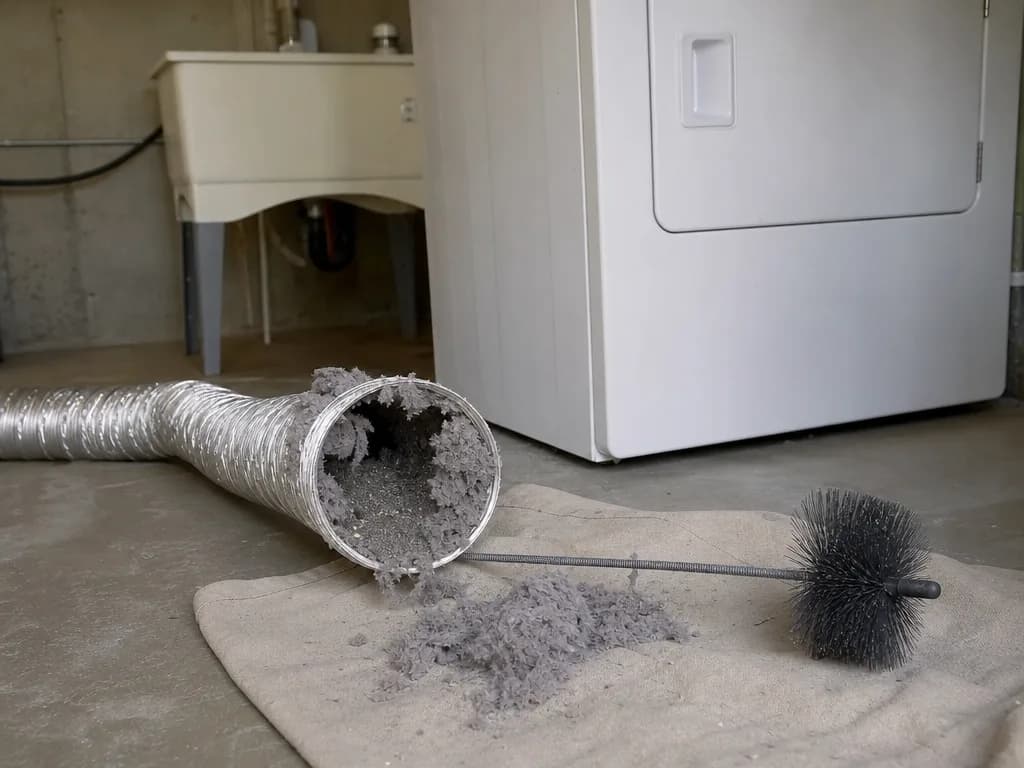
Why a dryer vent clogs and what the lint does
A dryer pushes warm, damp air and fine fibers out through a duct to the outside. The lint screen catches most of the fibers. The rest travel down the duct and settle on its walls, on every seam and at every bend. The more they pile up, the less air gets out, the longer the clothes take to dry and the hotter the dryer runs. The Consumer Product Safety Commission (CPSC) puts it in one sentence: lint “can block the flow of air, cause excessive heat build-up, and result in a fire in some dryers” (CPSC, Overheated Clothes Dryers Can Cause Fires (Publication 5022) (revised February 21, 2012)).
Three federal and national counts show how often that goes wrong. They measure different things over different years, so they are listed side by side and never added together.
- NFPA, 2014 to 2018: fire departments responded to an estimated average of 13,820 home fires a year in which a dryer was involved in the ignition, with seven civilian deaths, 344 injuries and $233 million in direct property damage a year. Failure to clean caused 32 percent of them, and 27 percent started when dust, fiber or lint ignited (NFPA, Home Dryer Fires (Index No. 3029) (June 2020, data 2014 to 2018)).
- CPSC staff, 2021 to 2023: an estimated 4,900 dryer fires a year in homes (CPSC, 2021 to 2023 Residential Fire Loss Estimates (October 2026)). CPSC counts differently from NFPA, so the two numbers do not conflict.
- USFA, 2008 to 2010: 2,900 clothes dryer fires a year in residential buildings reported to fire departments. Failure to clean was the leading contributing factor at 34 percent (USFA, Clothes Dryer Fires in Residential Buildings (2008 to 2010) (August 2012)).
The counts differ because each source uses a different database and a different set of years. What the three agree on is the cause: failure to clean is the top factor in each. NFPA also notes that dryers are a small share of all home fires, and that gas dryers appear in fires in about the same proportion as their share of the homes that own them, so gas is not the riskier kind (NFPA, Home Dryer Fires (Index No. 3029) (June 2020, data 2014 to 2018)). None of these sources promises that a cleaning prevents a fire. They show what usually goes wrong.
Timing matters too. The USFA report found dryer fires were more frequent in the fall and winter and peaked in January at 11 percent of the year's total, and 82.6 percent of them began in the laundry area (national data, 2008 to 2010; USFA, Clothes Dryer Fires in Residential Buildings (2008 to 2010) (August 2012)). That is a national pattern, not a Rockford count.
A Rockford example
The Rockford Register Star reported on May 31, 2012: “A fire that started about 10:56 a.m. today in an improperly vented dryer damaged a home in the 1200 block of Revell Avenue” (Rockford Register Star, Rockford house fire started in improperly vented dryer (May 31, 2012)). The rest of the article is behind a paywall, so that one sentence is all this page relies on.
Signs your dryer vent is clogged
Most of these show up in the laundry room before anything else does. Each one below comes from a federal agency or a dryer maker.
- Clothes are still damp after a normal cycle. CPSC says damp clothes at the end of a typical cycle, or drying that takes longer than normal, “may be a sign that the lint screen or the exhaust duct is blocked” (CPSC, Overheated Clothes Dryers Can Cause Fires (Publication 5022) (revised February 21, 2012)). Samsung is more direct: if the dryer is heating but the clothes are still damp, “your vent is probably blocked” (Samsung, Clothes are not dry after using Samsung dryer (July 2024)).
- The dryer or the laundry room is hot, or smells of burning. Whirlpool lists longer drying times, a dryer hot to the touch and a burning scent as signs the vent may need cleaning (Whirlpool, How to clean a dryer vent (March 2022)). GE adds that a dryer can sweat and run hot when the exhaust is restricted (GE Appliances, Dryer hot to the touch or sweats (undated)).
- Little or no air at the outside cap. CPSC's test: check the outside vent while the dryer is running, and if exhaust air is not escaping, the vent or the duct may be blocked. USFA adds that the flap on the outside covering should open when the dryer runs (USFA, Clothes Dryer Fires in Residential Buildings (2008 to 2010) (August 2012)).
- A crushed, kinked or visibly damaged duct behind the dryer. Whirlpool treats visible damage as a sign the duct needs replacing, not just cleaning.
- A blockage code on a Samsung dryer. Some Samsung models run a vent blockage test and report a code such as C8 or C80 for about 80 percent clogged (Samsung, How to clean your Samsung dryer (December 2025)). That is a model-specific feature, so a dryer without it can still be blocked.
Other things cause slow drying too: a full lint screen, a crushed hose, or dryer sheet residue on the moisture sensor. A technician can tell them apart. The signs of a clogged dryer vent guide goes through each check you can do yourself in five minutes.
How often to clean a dryer vent
No single rule exists. The federal government and the dryer makers give different answers, and this page shows all of them so you can pick with your own laundry habits in mind.
- CPSC: “Clean lint out of the vent pipe at least once a year” (CPSC news release, Save Daylight, Save Lives (March 8, 2023)).
- GE Appliances: inspect and clean the exhaust duct at least once a year (GE Appliances, Dryer hot to the touch or sweats (undated)).
- Samsung: once or twice a year, whether or not you notice a problem (Samsung, Clothes are not dry after using Samsung dryer (July 2024)).
- Whirlpool: “no less than once every two years,” depending on use and the loads you dry (Whirlpool, How to clean a dryer vent (March 2022)). Its Check Vent light page says every one to two years, or sooner when drying performance drops (Whirlpool Product Help, Check Vent light (December 2019)).
- Thumbtack's cost page says ideally every six months (Thumbtack, dryer vent cleaning cost (updated July 8, 2026)), and Angi says a longer-than-average vent may need it a couple of times a year.
Read that spread as a floor and a ceiling. A one-person household with a short vent sits near the long end. A family drying towels, bedding and pet-hair-covered loads, with a long run to the outside, sits near the short end. Whirlpool names frequency of use, the kind of items and pet hair as the reasons to go sooner. The how often guide helps you place your own house on that scale.
What a cleaning covers, and what it does not
A dryer vent cleaning is a cleaning of the exhaust path, from the back of the dryer to the outside wall. It does not clean the machine.
What the visit should cover
- The technician pulls the dryer out and disconnects the duct from the back. On a gas dryer the gas is turned off first, as Samsung's own steps say.
- A rotary brush on flexible rods, or a similar tool, is run through the duct from one end or both, with a vacuum pulling the lint out.
- The outside cap or hood is cleared of lint, and of any nest or debris, and its flap is checked to see that it opens.
- The duct is looked over for crushing, gaps, loose joints and screws that stick into the airflow, and the length and number of bends are noted.
- The duct is reconnected and sealed, the dryer is pushed back, and airflow at the outside cap is checked with the dryer running.
What it does not cover
The inside of the dryer cabinet is a separate job. CPSC says to “have a qualified service person clean the interior of the dryer chassis periodically” and to clean behind the dryer where lint builds up (CPSC, Overheated Clothes Dryers Can Cause Fires (Publication 5022) (revised February 21, 2012)). Ask whether the visit includes the dryer interior before you book. A cleaning also does not repair a duct that is damaged, too long or built wrong. That is a replacement or a reroute, priced separately below. And it does not fix the dryer itself: GE notes that venting problems are not a manufacturing defect and are not covered by the warranty (GE Appliances, Dryer hot to the touch or sweats (undated)).
What the code says about the duct
Chapter 15 of the International Residential Code (IRC) covers dryer exhaust in one- and two-family homes. These rules read the same in the 2021 and 2015 editions (ICC, 2021 International Residential Code, Chapter 15 Exhaust Systems (2021 edition) and ICC, 2015 International Residential Code, Chapter 15 Exhaust Systems (2015 edition)), and they are what a good installer builds to and a good cleaner looks for.
- Independent, to the outdoors. A dryer exhaust system “shall be independent of all other systems and shall convey the moisture to the outdoors.” Venting into an attic, crawl space or garage does not meet that. The Department of Energy's weatherization job aid says “ducted to exterior” does not include unconditioned attics or crawl spaces (U.S. Department of Energy, Weatherization Installer Job Aid 17-1: Vent a Clothes Dryer (June 2024)).
- Smooth metal, 4 inches across. The duct has a smooth interior and is metal not thinner than No. 28 gage, 4 inches nominal in diameter.
- Short. Maximum length 35 feet, counted from the connection at the dryer to the outside terminal, and reduced for every fitting. A 4-inch mitered 90 degree elbow counts as 5 feet. A run that goes past 35 feet of equivalent length has to carry a permanent label with the length, within 6 feet of the duct connection. The dryer maker can set a different limit in its instructions, and the manual wins.
- No screens at the end. “Screens shall not be installed at the duct termination,” because lint clogs them. The 2021 text also requires the opening to be undiminished with an open area of at least 12.5 square inches.
- Screws may not poke into the airflow. Ducts cannot be joined with screws or similar fasteners that protrude more than 1/8 inch into the inside of the duct, since a long screw tip catches lint like a hook.
- Backdraft damper and distance. The 2015 text says the termination is “equipped with a backdraft damper” and sits not less than 3 feet from openings into buildings unless the maker says otherwise. The 2021 fuel gas chapter (G2439.3) repeats the damper rule for gas dryers (ICC, 2021 International Residential Code, Chapter 24 Fuel Gas (2021 edition)).
- Transition duct. The short piece that connects the dryer to the wall duct has to be a single length, listed and labeled to UL 2158A, no longer than 8 feet, and not hidden in the construction. It is the only place the IRC allows a flexible duct.
- Shield plates. Where a nail or screw from finish work could pierce the duct, protective plates go over the framing.
Two cautions. First, this page does not quote a duct support spacing. The 2021 IRC gives 12 feet in Chapter 15 and 4 feet in the fuel gas chapter for the same kind of duct, so ask the inspector or follow the dryer maker's instructions. Second, the Department of Energy job aid suggests a booster fan when a run must exceed 35 feet, but Whirlpool says it gives no recommendation for booster fans, and the IRC allows a labeled long run or a UL 705 listed fan. Get the maker's position before adding one.
Which edition applies in your town
The edition depends on the office that issues your permit. From the offices' own pages: Rockford, Loves Park, Machesney Park and Winnebago adopted the 2021 IRC, in some cases with local amendments. Roscoe, Rockton, South Beloit, Cherry Valley, Durand, New Milford, Lake Summerset, Westlake Village and Argyle fall under the Winnebago County Building Division, which lists the 2015 IRC. The county's code page may be out of date, so confirm with the office before a reroute. Pecatonica's pages name chimney inspections but give no IRC edition, and nothing on this page claims a local dryer rule beyond those code editions. The dryer vent code guide covers the rest of the text.
Foil and plastic accordion duct
The silver or white ribbed, stretchy hose is the duct CPSC tells you to replace: “Replace plastic or foil, accordion-type ducting material with rigid or corrugated semi-rigid metal duct.” The reason is lint and airflow, not the material itself. CPSC says the flexible type “can more easily trap lint and is more susceptible to kinks or crushing, which can greatly reduce the airflow” (CPSC, Overheated Clothes Dryers Can Cause Fires (Publication 5022) (revised February 21, 2012)).
Whirlpool's venting sheet goes further. It says not to install a dryer with flexible plastic or flexible metal foil duct unless the maker names the specific type as suitable, because flexible venting is known to collapse, be crushed and trap lint (Whirlpool, dryer venting specifications (November 2023)). Its sheet also warns against PVC, since the pipe wall holds less heat than metal, moisture condenses inside it and lint sticks to the wet walls. So the practical rule is: rigid metal for the wall run, and a short listed transition piece only at the dryer. If your duct is foil or vinyl, a cleaning is worth much less than a replacement, because CPSC says the flexible type traps lint more easily.
Gas dryers, carbon monoxide and snow on the cap
A gas dryer vents combustion gas as well as moisture. The 2021 IRC says its exhaust system must “convey the moisture and any products of combustion to the outside of the building” and that the duct cannot be connected to a vent connector, vent or chimney (ICC, 2021 International Residential Code, Chapter 24 Fuel Gas (2021 edition)). GE warns never to run a gas dryer with the vent disconnected, because “possible carbon monoxide fumes could enter the room” (GE Appliances, Dryer hot to the touch or sweats (undated)). So a blocked vent on a gas dryer is a fire question and a carbon monoxide question.
The Illinois Office of the State Fire Marshal lists dryers among the faulty or poorly repaired appliances that can produce carbon monoxide (Illinois Office of the State Fire Marshal, carbon monoxide warning (undated)). Illinois law also requires a working carbon monoxide alarm within 15 feet of every room used for sleeping, and the State Fire Marshal says it applies to homes that burn fossil fuel, natural gas included, or have an attached garage. See the Illinois alarm law guide.
Winter adds a plain, outdoor risk. Rockford averages 21.8 F in January (National Weather Service, 1991 to 2020 normals), and snow or ice can cover the wall cap. Nicor Gas, an Illinois gas utility, says snow or ice covering “the outside venting of a furnace, water heater or clothes dryer can cause hazardous buildup of carbon monoxide,” and says to clear it with your hands or a broom, not a shovel or mechanical equipment (Nicor Gas, customer safety insert (fourth quarter 2020)). GE says the same for the cap: snow or ice “should not be allowed to accumulate around the outside wall cap.” Both statements are general safety advice. Neither is a Rockford-specific finding, but the January average shows why a low wall cap can be buried here for weeks.
Two more cold-weather points from the same sources. GE says a dryer should be used in a heated location, because in an unheated space in the cooler months it can condense and sweat. And the Building America Solution Center, a Department of Energy program, advises insulating a duct that crosses an unconditioned space in cold climates, to avoid condensation inside the duct (Building America Solution Center (DOE), Proper Clothes Dryer Venting (October 2022)).
What dryer vent cleaning costs
Typical price, national
- Cleaning: $104 to $188. Angi, dryer vent cleaning cost, updated October 14, 2026.
- Cleaning: $186 to $510. Thumbtack, dryer vent cleaning cost, updated July 8, 2026.
No cost guide publishes a Rockford, Chicago or Illinois chimney price (Angi's Chicago pages return 404, and HomeGuide and Thumbtack have none), so every range on this site is a national figure and is labelled that way.
Angi, dryer vent cleaning cost (updated October 14, 2026) puts a cleaning at $104 to $188, averaging $145. Thumbtack, dryer vent cleaning cost (updated July 8, 2026) says $186 to $510, with most people paying around $307. The two guides are far apart, so treat both as national ranges and get a written price from anyone you call. Angi's ranges follow the vent: by vent location, a basement or first-floor vent $80 to $150, second floor $110 to $185, roof $150 to $250. The vent's length and the number of turns matter more than its type.
Extra jobs and what they add
Typical price, national
- Nest, fur or dropping removal at the cap (on top of the cleaning): $120 to $250. Angi, dryer vent cleaning cost, updated October 14, 2026.
- Vent guard on the outside cap: $30 to $100. Angi, dryer vent cleaning cost, updated October 14, 2026.
- Replace an existing vent (HomeGuide): $100 to $300. HomeGuide, dryer vent installation and replacement cost, written January 5, 2026.
- Damaged vent repair or replacement (Angi): $80 to $1,000. Angi, dryer vent cleaning cost, updated October 14, 2026.
- New vent through an exterior wall: $200 to $800. HomeGuide, dryer vent installation and replacement cost, written January 5, 2026.
- Full reroute: $200 to $500. HomeGuide, dryer vent repair and reroute cost, written May 27, 2026.
HomeGuide's reroute figure is a loose range that ends in "and up", so a long or awkward run can cost more. Angi's damaged-vent row is $80 to $1,000, which depends on what is wrong.
A new vent, a reroute or a replacement is a different kind of work from a cleaning. These are the jobs where a cleaning visit turns up a problem that only a replacement fixes. See the cost page for how these figures sit beside the chimney jobs.
Who does the work, and what to ask
Illinois does not license dryer vent cleaners. The Illinois Attorney General's contractor guide says “General contractors are not required to be licensed or certified,” though they may need a permit from the municipality (Illinois Attorney General, How to Choose a Contractor (undated)). That guide does regulate roofers, which only matters if a vent job involves roof work. No Illinois source we found mentions a dryer vent license, so the quality of a company is something you check yourself.
One credential does exist. The Chimney Safety Institute of America runs the Certified Dryer Exhaust Technician program, which it calls the only nationally recognized credential for dryer vent cleaning (CSIA, Certified Dryer Exhaust Technician (2026)). That is CSIA's own description. It is a technician credential, not a state license, and it is separate from CSIA's chimney sweep certification. The National Air Duct Cleaners Association announced on September 17, 2026 that it is developing a dryer vent technician certificate and a standard (NADCA, dryer vent technician certificate program announcement (September 17, 2026)), which is not yet a full certification. This site does not claim any credential for anyone. Here is what to ask:
- Does the person doing the work hold a current CSIA Certified Dryer Exhaust Technician credential, and can I see it?
- Do you clean the full run, including the outside cap, and do you check airflow at the cap afterward?
- Do you open the dryer to clean its interior, or is that extra?
- What is the price for my vent, in writing, including any charge for a roof exit, a long run or a nest?
- If you find a crushed, foil or too-long duct, will you show me and quote the fix separately?
- Will you shut off the gas first on a gas dryer and test for leaks after?
The written-contract rule starts above $1,000. A cleaning priced under that is below it. A reroute or replacement can cross the line, and if it does the Home Repair and Remodeling Act applies:
Written contract over $1,000
“Prior to initiating home repair or remodeling work for over $1,000, a person engaged in the business of home repair or remodeling shall furnish to the customer for signature a written contract or work order that states the total cost, including parts and materials listed with reasonable particularity and any charge for an estimate.”
The Act names several home improvements, so check whether a given vent job counts before relying on it. Either way, get the scope and the price on paper.
Doing it yourself, or hiring it out
A homeowner can do the job. Samsung publishes the steps and a tool list: a vent cleaning kit with a brush and extension rods, a drill, a vacuum, a screwdriver, pliers and tape. It still says “a professional vent cleaning service is recommended” and starts the steps with “if you have a gas dryer, turn off the gas and unplug the dryer.” USFA says the dryer interior and the venting should be serviced and cleaned periodically by qualified service personnel (USFA, Clothes Dryer Fires in Residential Buildings (2008 to 2010) (August 2012)). No safety source we found says DIY is unsafe. The honest case against it is access and follow-through: a roof exit, a long run, a second-floor vent, or a duct you cannot see the end of.
The DIY dryer vent guide lists what to do and where to stop. A rule of thumb from the sources: if the duct is damaged, if the vent exits on a roof, or if it is a gas dryer and you are not sure of the gas connection, hire it out.
Dryer vents in Rockford homes
Winnebago County heats mostly with gas: 83.5% of homes (Census ACS 5-year). That means furnace and water heater flues share most basements and utility rooms with the dryer, and gas dryers share the same gas supply. Nicor Gas advises a yearly cleaning or inspection of gas appliances by a certified contractor, which is a different visit from a dryer vent cleaning. Rockford is also an older city, with 22.4% of its housing units built before 1940 and a median build year of 1963. We found no source that says Rockford houses have longer or worse dryer runs than other places, so this page does not assert it. What the age does tell you is that the laundry setup in many houses was added after the house was built, and that is worth checking on a visit: the length, the turns and where the duct ends.
Angi prices by vent location, and a basement or first-floor vent is the cheapest tier. For nearby towns, see Loves Park and Machesney Park. The full list is on the service area page.
Tell us the town, the dryer type (gas or electric), where the vent exits and what you have noticed. We reply with a price first.
Sources: NFPA, Home Dryer Fires (Index No. 3029); CPSC, 2021 to 2023 Residential Fire Loss Estimates; USFA, Clothes Dryer Fires in Residential Buildings (2008 to 2010); CPSC, Overheated Clothes Dryers Can Cause Fires (Publication 5022); CPSC news release, Save Daylight, Save Lives; Whirlpool, How to clean a dryer vent; Whirlpool Product Help, Check Vent light; Whirlpool, dryer venting specifications; Samsung, How to clean your Samsung dryer; Samsung, Clothes are not dry after using Samsung dryer; GE Appliances, Dryer hot to the touch or sweats; ICC, 2021 International Residential Code, Chapter 15 Exhaust Systems; ICC, 2015 International Residential Code, Chapter 15 Exhaust Systems; ICC, 2021 International Residential Code, Chapter 24 Fuel Gas; U.S. Department of Energy, Weatherization Installer Job Aid 17-1: Vent a Clothes Dryer; Building America Solution Center (DOE), Proper Clothes Dryer Venting; Illinois Office of the State Fire Marshal, carbon monoxide warning; Nicor Gas, customer safety insert; Rockford Register Star, Rockford house fire started in improperly vented dryer; CSIA, Certified Dryer Exhaust Technician; NADCA, dryer vent technician certificate program announcement; Illinois Attorney General, How to Choose a Contractor; Home Repair and Remodeling Act, 815 ILCS 513/15; Angi, dryer vent cleaning cost; Thumbtack, dryer vent cleaning cost; HomeGuide, dryer vent installation and replacement cost; HomeGuide, dryer vent repair and reroute cost; Nicor Gas, safety precautions; National Weather Service, Rockford normals 1991-2020; U.S. Census Bureau, ACS 2020-2024 5-year, via Census Reporter
Where this is done
Dryer Vent Cleaning across Winnebago County. Each town page has its own local rules and numbers; the rest are on the service area page.
Common questions
Dryer Vent Cleaning: questions
How much does dryer vent cleaning cost?
Angi shows $104 to $188 and Thumbtack $186 to $510, both national guides with no Rockford price. A basement or first-floor vent costs least and a roof vent most. See the cost page for the other jobs.
How often should a dryer vent be cleaned?
The sources differ. CPSC says at least once a year, Samsung says once or twice a year, and Whirlpool says no less than once every two years. Use more often for a long run, pet hair or heavy loads.
How do I know my dryer vent is clogged?
Clothes stay damp after a normal cycle, the dryer or laundry room gets hot, or you smell burning. CPSC also says to run the dryer and check the outside cap, since weak or no airflow there points to a blockage.
Is dryer vent cleaning worth it?
The fire data points to the cause. NFPA found failure to clean behind 32 percent of dryer fires (2014 to 2018) and USFA found 34 percent (2008 to 2010). Neither source promises that a cleaning prevents a fire, and neither compares professional with DIY cleaning.
Is foil or plastic accordion duct safe for a dryer?
CPSC says to replace it with rigid or corrugated semi-rigid metal duct, because the flexible type traps lint and is easily kinked or crushed. The IRC allows only a short, listed transition duct. Cleaning a foil duct does not fix the shape that catches lint.
How long can a dryer vent be?
The IRC sets 35 feet for the duct, less an allowance for each fitting, and a 4-inch mitered 90 degree elbow counts as 5 feet. The dryer maker can set a different limit, and the manual then governs. Confirm which IRC edition your permit office uses.
Does Illinois license dryer vent cleaners?
No Illinois dryer vent license was found, and the Attorney General says general contractors are not required to be licensed. The CSIA Certified Dryer Exhaust Technician credential exists, so ask whether the person doing the work holds it and ask to see it.
Can I clean my own dryer vent?
Samsung publishes DIY steps and tools but recommends a professional service. Turn off the gas on a gas dryer first, check the duct for damage, and reconnect everything before using the dryer. Read the DIY guide first.
Other services
Dryer Vent Cleaning in Winnebago County
Tell us what you burn, when the chimney was last swept and what you have noticed. We reply with a price first, and nothing starts until you agree to it.